

Marketing today is not limited to advertising, promotions, or creating content on social media. A campaign can generate significant reach and still be ineffective if a business does not truly understand its customers and the value it provides.
According to Philip Kotler and Gary Armstrong in Principles of Marketing (2014), marketing is the process of creating value for customers and building strong relationships with them in order to capture value in return.
Marketing, therefore, should not be viewed as a collection of separate tools or communication activities. Behind every Marketing decision, businesses need principles that help determine how to understand the market, what value to create, and how to deliver that value to customers. This is the foundation of Marketing Principles.
What Are Marketing Principles?
Marketing Principles can be understood as the core principles and foundations that guide how businesses research the market, understand customers, create value, build brands, and deliver that value to the right audience.
Marketing is therefore not the same as advertising. It includes a wide range of activities aimed at identifying, anticipating, and satisfying customer needs, while advertising is a form of paid communication used to deliver a message to a specific audience.
The Principles of Marketing textbook by OpenStax describes the marketing process as beginning with understanding the marketplace and customer needs, followed by developing a customer-driven strategy, creating value, and building customer relationships.
Understanding Marketing Principles allows businesses to view Marketing as a process of creating and exchanging value rather than simply focusing on advertising or selling. However, to apply this approach in practice, businesses need to understand the principles behind each Marketing decision from understanding customers and conducting market research to identifying target markets, creating value, and maintaining long-term relationships.
These principles can therefore be viewed as the foundation for guiding the entire Marketing process.
Core Marketing Principles Every Business Should Understand
1. Customer-Centricity: Putting the Customer at the Center
The first Marketing principle is to understand customers before trying to sell to them. Instead of starting with the question, “What products does our company have?”, Marketing should begin with, “What do our customers need?”
Understanding the market and customers’ needs and wants is the first step in the Marketing process. Businesses can then develop customer-driven Marketing Strategies and create superior value.
Example: A fashion brand should not only communicate the material, color, or design of a shirt. The brand needs to answer what problem the shirt helps customers solve: Does it make dressing for work more convenient? Is it easier to style? Or does it create an image that fits their lifestyle?
To truly understand customers rather than relying on assumptions, businesses need specific data and research methods. This is why Marketing Research becomes the next step in the Marketing decision-making process.
2. Marketing Research: Understand the Market Before Taking Action
Another important Marketing principle is to make decisions based on market understanding rather than intuition alone.
According to the American Marketing Association, Marketing Research connects organizations with consumers, customers, and markets through information, supporting the identification of problems, opportunities, and decision-making.
Businesses can collect Marketing data through surveys, interviews, social listening, website data, purchasing behavior, customer feedback, competitor research, and the results of previous Marketing campaigns.
These sources help businesses gain a clearer understanding of customers and the market, providing a stronger foundation for making appropriate Marketing decisions.
For FIX Agency, this is an important step in avoiding situations such as “creating content because competitors are doing it” or “jumping on a trend because it is going viral” without understanding whether the activity is actually relevant to the brand’s objectives.
However, understanding the market alone is not enough. Based on the data collected, businesses need to determine which customer groups they should prioritize and what position they want the brand to occupy in those customers’ minds. This is where STP comes into play.
3. STP Marketing: Identifying the Right Customers and Brand Position
One of the fundamental Marketing principles is that businesses should not assume that one product is suitable for everyone.
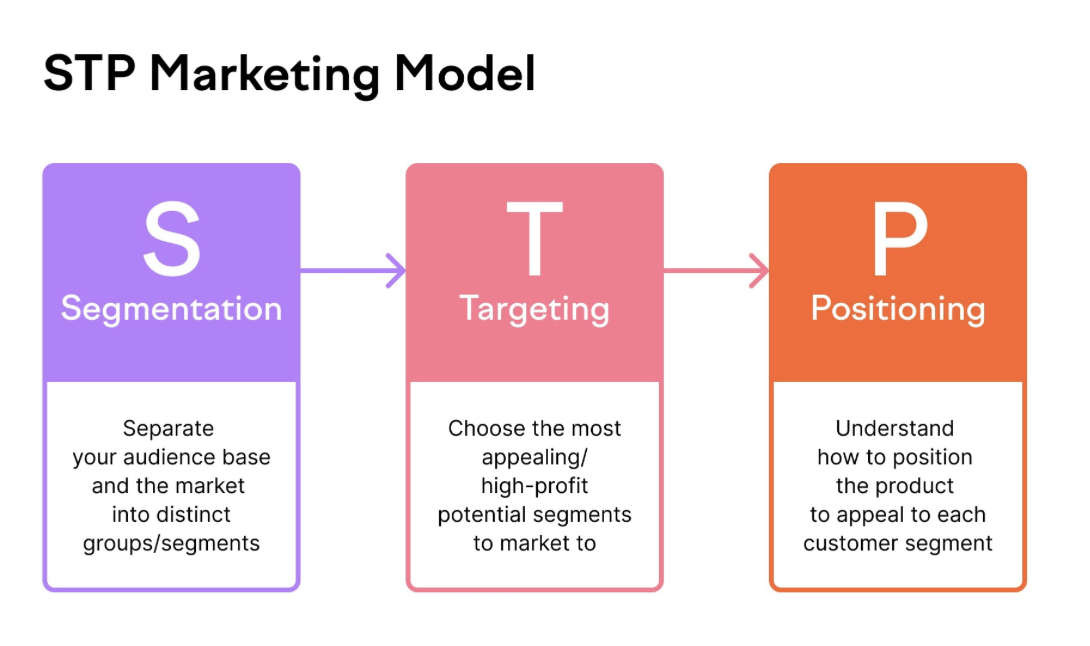
The market needs to be divided into customer groups with similar characteristics, needs, or behaviors. This is the foundation of STP – Segmentation, Targeting, and Positioning.
- Segmentation: Divide the market into distinct customer groups.
- Targeting: Select the customer groups the business wants to focus on.
- Positioning: Define the position and brand image the business wants to establish in the minds of those customers.
The Core Principles of Marketing textbook from Washington State University includes a dedicated chapter on Market Segmentation, Targeting, and Positioning, explaining how businesses can divide markets, select target markets, and develop positioning for products or brands.
When the target customer is clearly defined, businesses can make better decisions about which products to develop, what messages to communicate, which channels to prioritize, and what types of content are most likely to create meaningful connections.
However, identifying the right customers and brand position is only the strategic starting point. Businesses must then translate these choices into specific decisions about products, pricing, distribution, and communication. This is where the Marketing Mix plays an important role.
4. Marketing Mix: Making the 4Ps Work Together
The Marketing Mix is one of the most fundamental concepts in Marketing Principles. The Marketing Mix is commonly represented by four elements: Product, Price, Place, and Promotion.
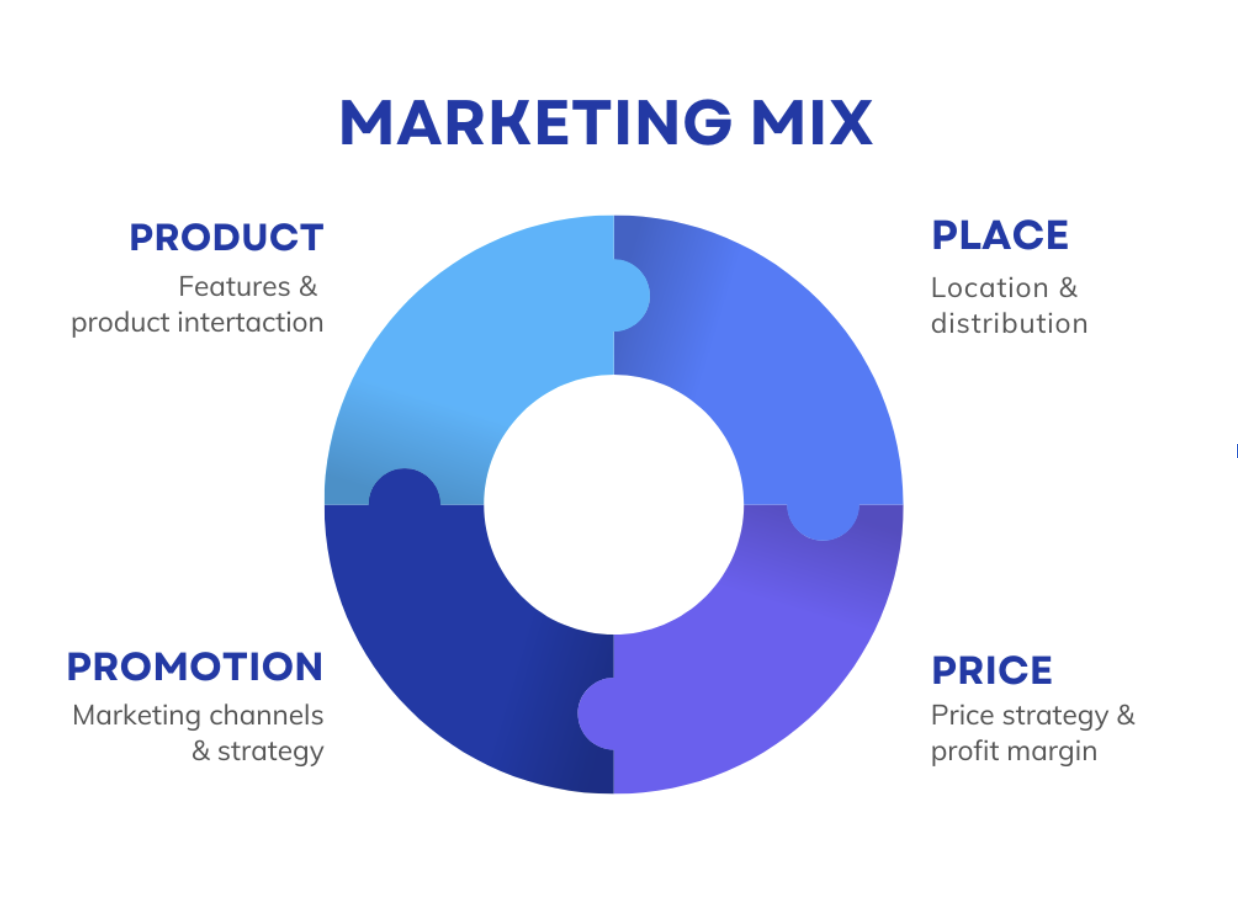
Product
Product does not simply answer the question, “What product or service does the business sell?” It also needs to answer, “What customer need does the product address, and what value does it create?”
Businesses need to consider factors such as features, quality, design, appearance, packaging, branding, and user experience. More importantly, these characteristics need to connect with the needs of the target customers and the positioning the brand is pursuing.
For example, if a business positions its product around convenience, product development should not simply focus on adding more features. The business should consider elements that make the product easier to use, save customers time, or reduce problems during the user experience.
In other words, Product is where the Value Proposition is translated into a tangible product or experience that customers can recognize and use.
Price
Price is not simply a number placed on a product. It is a decision directly related to perceived customer value, brand positioning, and the business’s ability to generate revenue.
When developing a pricing strategy, businesses need to consider factors such as customer value, costs, competitors’ prices, customers’ purchasing power, revenue objectives, profit, and market share.
Pricing should be connected to both the actual and perceived value of the product while also taking costs and competitive conditions into account. More importantly, price can become part of a brand’s positioning. A premium brand, for example, cannot necessarily compete by continuously lowering prices, while a brand focused on broad accessibility needs to consider a price level that fits the scale of its target market.
Therefore, Price should be considered in relation to Product and Positioning, rather than being determined solely by production costs or competitors’ prices.
Place
Place answers the question: “Where, how, and how conveniently can customers access and purchase the product?”
Place is not simply a choice between a physical store and a website. It also includes how a business organizes its distribution system, inventory, delivery, and touchpoints that help bring products to customers.
Depending on the business model, companies may choose:
- Physical stores
- Brand websites
- E-commerce platforms
- Social commerce
- Dealers and distributors
- Direct sales channels
- A combination of online and offline channels
The key is not to have as many channels as possible. Distribution channels need to match the purchasing behavior of target customers and the business’s operational capabilities.
For example, if customers typically research products online but want to experience them in person before purchasing, a business can combine its website and social commerce with a physical store network.
On the other hand, if the product has a simple purchasing process and customers prioritize convenience, an online distribution model may play a larger role.
Promotion
Promotion is how a business communicates the value of its products to customers and encourages them to take actions aligned with Marketing objectives. It is one of the most visible elements of Marketing because customers frequently interact directly with advertising, content, PR, social media, email, and promotional campaigns.
However, Promotion is not the same as Marketing as a whole. It is only one of the four components of the Marketing Mix.
The Promotion Mix can include various approaches such as advertising, sales promotion, public relations, personal selling, direct marketing, and digital marketing.
The Marketing Mix therefore helps businesses answer questions about what value the product provides, what price is appropriate, where customers can access it, and how that value should be communicated.
However, choosing the right 4Ps does not automatically guarantee a consistent Marketing experience if customer touchpoints are executed in different directions. When customers interact with a brand through multiple channels and formats, businesses also need to ensure consistency across these activities.
5. Integrated Marketing Communication (IMC): Creating Consistency Across Marketing Activities
In today’s environment, customers can interact with a brand through websites, Facebook, TikTok, Instagram, advertising, physical stores, KOLs, or sales representatives.
Therefore, an important Marketing principle is that all touchpoints should communicate a consistent value proposition and positioning.
The AMA describes Marketing Strategy as a plan that guides a business’s Marketing activities while coordinating tactics and resources to achieve Marketing objectives.
This means that Marketing activities should not be implemented as independent “pieces.”
When different activities tell the same story, Marketing becomes more than a collection of separate campaigns it becomes an integrated system.
From FIX Agency’s perspective, this is also why businesses should not begin by asking, “How many Facebook posts should we publish?” Instead, they should first determine, “What do we want customers to understand and remember?”
However, a consistent message and a well-executed Marketing system are still not the ultimate goal. Marketing is not only about attracting customers; it must also create enough trust and long-term value to maintain relationships with them.
This moves Marketing beyond simply “communicating the right message” toward a broader requirement: businesses need to act transparently, responsibly, and consistently with what they promise.
6. Ethics & Long-Term Relationships: Building Long-Term Trust
A successful Marketing campaign should not be evaluated solely based on a single transaction.
Businesses need to pay attention to:
- Transparency of information
- Accuracy of messaging
- Customer experience
- Privacy
- Product/service quality
- After-sales support
- The ability to build customer loyalty
The AMA Statement of Ethics for Marketing emphasizes values such as honesty, responsibility, fairness, respect, and transparency.
Marketing ethics is also an important component of Marketing professionals’ capabilities, with principles related to avoiding harm, maintaining transparency, and ensuring fairness.
In the long term, brands do not compete only through who has the most visible advertising. They also compete through who can build stronger trust.
Viewed individually, Customer-Centricity, Marketing Research, STP, Marketing Mix, IMC, and Ethics may appear to be separate principles. In practice, however, they are not independent activities.
Understanding customers provides the foundation for research; research helps businesses select markets and establish positioning; positioning guides the Marketing Mix; the Marketing Mix needs to be communicated consistently across touchpoints; and the entire process should ultimately focus on creating value and building long-term customer relationships. This connection forms a continuous Marketing Process, rather than a collection of disconnected activities.
How Are Marketing Principles Connected?
The Marketing principles above do not operate independently. Instead, they are connected through a continuous process, from understanding customers and identifying target markets to creating value and building long-term relationships.
According to OpenStax – Marketing and the Marketing Process, the Marketing Process can be understood through five key steps:
- Understand the marketplace and customer needs.
- Develop a customer-driven Marketing Strategy.
- Build an integrated Marketing program that delivers superior value.
- Build profitable customer relationships.
- Capture value from customers.
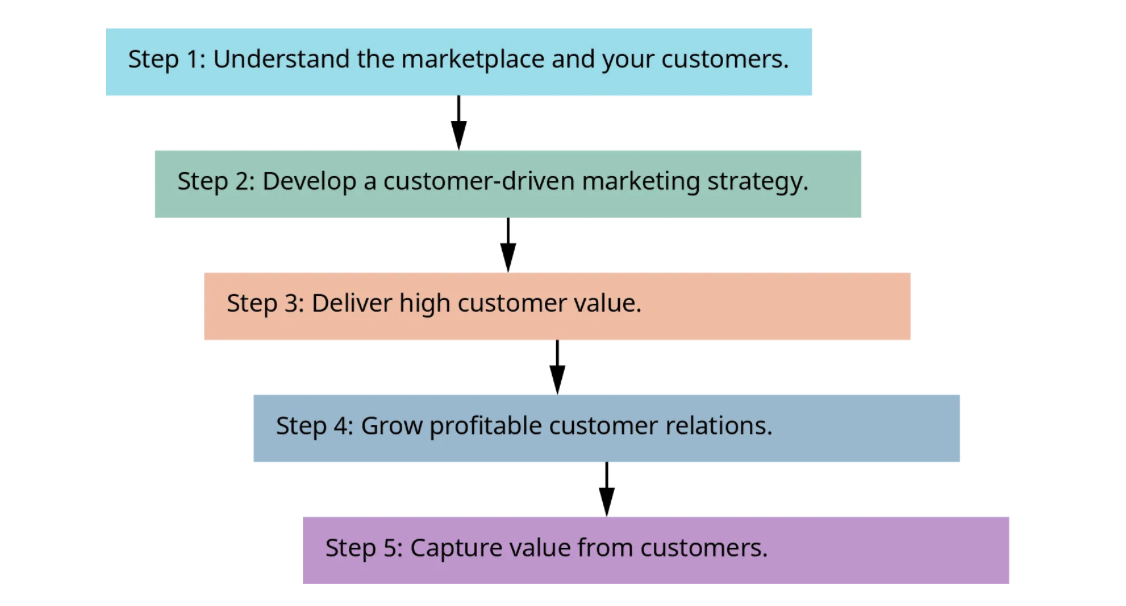
Therefore, rather than viewing Marketing Principles as separate formulas, businesses should see them as an interconnected system. The ultimate goal is not simply to generate a transaction, but to create value for customers and transform that value into sustainable business growth.
Viewing Marketing Principles as a system helps businesses understand how different Marketing decisions are connected. However, the value of such a system is only realized when businesses can use it to make decisions in practice.
Based on the Marketing Process above, businesses can turn these principles into a simple six-step process, from market research to measurement and optimization.
How Can Businesses Apply Marketing Principles?
Understanding Marketing Principles only creates real value when businesses can translate these principles into action. Your company can start with the following six basic steps:
1. Conduct Market Research
Collect information about customers, competitors, trends, and market opportunities to understand where the business currently stands and what the market needs.
2. Identify the Target Customer
Go beyond demographics to understand customers’ needs, motivations, behaviors, and pain points in order to identify the groups that can create the greatest value.
3. Build Value
Identify what problem the product or service solves, what benefits it provides, and why customers should choose the business over alternative options.
4. Develop Positioning
Define what the business wants customers to remember about the brand, where the brand is differentiated, and which values need to be communicated consistently.
5. Implement the Marketing Mix
Evaluate the alignment between Product, Price, Place, and Promotion, while also considering People, Process, and Physical Evidence if the business provides services or places a strong emphasis on customer experience.
6. Measure and Optimize
Marketing should not be evaluated solely through likes, views, or reach. Businesses should select KPIs based on objectives such as leads, conversion, revenue, retention, or customer satisfaction.
Key Marketing capabilities include market research, Marketing planning, customer value, targeting, and customer satisfaction. These capabilities demonstrate that Marketing should be approached as a continuous process of research – planning – value creation – execution – measurement – optimization.
Applying Marketing Principles does not necessarily have to begin with a large campaign or a new communication channel.
Businesses can start by reviewing each link in the process:
- Is the market properly understood?
- Is the target customer clearly defined?
- Are the value proposition and positioning sufficiently differentiated?
- Is the Marketing Mix appropriate?
- Are the results being measured correctly?
When these elements are connected, businesses have a stronger foundation for deciding which channels to invest in, which activities to implement, and how to allocate resources.
Therefore, Marketing Principles are not simply theoretical concepts. They can also serve as a framework for businesses to evaluate their entire Marketing operation before increasing budgets, expanding channels, or launching a new campaign.
Summary, Marketing does not begin with advertising. It begins with understanding customers and creating relevant value for them.
Understanding Marketing Principles helps businesses view Marketing as an interconnected system from customer research, market segmentation, and target customer identification to brand positioning, value creation, Marketing Mix, Content Marketing, Social Media, and Advertising.
At FIX Agency, we connect strategy and execution through Marketing, Branding, Digital, SEO, and Content solutions. If your company needs support in developing an effective Marketing Strategy, contact FIX Agency at 091.637.3146 for consultation.
About The Author

