
There has never been a shortage of marketing knowledge to learn. With just a few searches, you can access hundreds of courses, frameworks, templates, and tutorials covering Content, Social Media, SEO, Ads, and Planning.
However, having knowledge does not necessarily mean being able to apply it effectively in the workplace.
A professional may be skilled at content writing but still struggle to develop a complete marketing plan independently. A marketing team may have sufficient personnel and tools, yet its performance may fall short of expectations because each role operates differently. From a business perspective, these challenges often manifest as repeated revisions, slow execution, inconsistent output standards, or excessive reliance on a few experienced employees.
In such cases, another training course may not be what is missing. The real gaps may lie in foundational knowledge, strategic thinking, planning capabilities, or the way the team operates.
FIX Agency’s Training & Coaching service is designed to address these challenges. Rather than simply transferring knowledge, FIX combines Training, Coaching, and Operational Consulting to help individuals and businesses build strong foundations, apply knowledge to real-world challenges, and progressively turn what they have learned into practical capabilities they can use in their daily work.
1. Why Do Businesses Still Struggle with Marketing Operations Despite Having the Knowledge?
Today, the challenge rarely comes from a lack of access to information. On the contrary, exposure to too much fragmented knowledge can make it difficult for learners to identify what they should prioritize.
Beginners may start by learning Content, then move on to Social Media, Ads, or SEO, without fully understanding how these activities connect within a comprehensive marketing plan.
For working professionals, the challenge is different. They may be comfortable executing assigned tasks, but when required to define objectives independently, develop a plan, or handle an unfamiliar situation, their task-specific execution experience begins to reach its limits.
For businesses, the issue often extends beyond individual capabilities. A team may have all the necessary roles, including Content, Design, Ads, and Sales. However, without a shared understanding of objectives, clearly defined workflows, or consistent standards across team members, achieving aligned outcomes remains difficult.
Therefore, the question is not always, “What else do we need to learn?”
More importantly, businesses need to determine where their teams currently stand, where the bottlenecks exist, and which capabilities need to be developed to achieve their next objectives.
That is also where an effective training or coaching program should begin.
2. What Is FIX Agency’s Training & Coaching Service?
At FIX, Training, Coaching, and Operational Consulting are not treated as three separate activities. They are interconnected to address three dimensions of the same challenge: understanding concepts correctly, applying knowledge effectively, and improving operational performance.
Training – Building Strong Foundations Before Moving into Practical Application
Training helps learners establish or strengthen the essential knowledge they need before moving into specific tools and real-world cases.
Depending on their starting point, the curriculum may cover Marketing Fundamentals, Content, Planning, soft skills, and operational thinking. Knowledge is also placed within the context of current market conditions, enabling learners not only to understand a framework but also to recognize why it is used, when it is appropriate, and when adjustments are necessary.
For beginners, this stage establishes a solid foundation. For experienced professionals, training provides an opportunity to revisit existing knowledge, stay updated on recent developments, and address knowledge gaps that may be limiting their next stage of growth.
Coaching – Applying Knowledge to Real Challenges
Once the necessary foundation is established, Coaching helps learners connect their knowledge more directly to their actual work.
An ongoing marketing plan, an underperforming content system, a Social Media Plan lacking strategic direction, or a workflow creating team bottlenecks can all become cases for analysis.
Using the available data and business context, mentors work alongside learners to revisit root causes, identify priority issues, and determine appropriate solutions.
The key is not simply receiving an answer to “What should I do?” Learners also need to understand why a particular approach is selected, which factors influence the decision, and what should change if the circumstances are no longer the same.
This allows knowledge to be applied directly during the learning process, rather than requiring learners to figure out how to put it into practice only after completing the program.
Operational Consulting – When Bottlenecks Lie in Organizational Operations
At the business level, not every challenge can be resolved through additional professional training.
In some cases, employees have the necessary skills, but workflows remain unclear. A team may be capable, yet responsibilities overlap across roles. Marketing and Sales may pursue the same business objectives while operating as two separate systems.
In these situations, FIX can extend its support beyond Coaching into Operational Consulting, addressing processes, KPIs, dashboards, SOPs, reporting, guidelines, and cross-departmental collaboration.
The objective is to ensure that knowledge does not remain isolated within individual employees but gradually becomes part of an organizational approach that can be implemented, measured, and repeated consistently.
These three dimensions also provide the foundation for understanding how FIX’s coaching methodology differs from a conventional marketing course built around a fixed curriculum.
3. What Makes FIX’s Approach Different?
FIX’s differentiation does not come from attempting to deliver as much knowledge as possible within a single program. What matters more is identifying the specific knowledge and capabilities that are missing and applying them in the right context.
Starting with the Problem, Not the Syllabus
Someone entering the marketing industry cannot follow the same learning path as an experienced Marketing Executive. Similarly, a Founder who wants to understand marketing to manage a business does not need the same training as a Content Specialist.
For this reason, FIX does not assume that every participant should follow an identical curriculum.
Before the program begins, each learner’s existing knowledge, challenges, and objectives are discussed and assessed. The learning roadmap is then developed based on the gap between their current capabilities and the capabilities they need to achieve.
Personalization, in this context, goes beyond adjusting the teaching style while using the same slide deck. The content, learning sequence, and depth of instruction can all be tailored to individual circumstances.
Practical Frameworks Without Overlooking the Fundamentals
FIX develops its frameworks based on real-world operational and execution experience. However, being practical does not mean eliminating theory and focusing exclusively on tips and techniques.
Without understanding the underlying principles, learners may be able to apply a formula in Situation A but struggle when faced with Situation B.
That is why the learning process still requires a solid theoretical foundation before knowledge is applied to real-world cases, data, and business challenges.
Case Studies Go Beyond Presentation Slides
Another key difference is that case studies can come directly from the learner’s own work or the organization’s actual business activities.
Instead of discussing only what a hypothetical brand should do, Coaching can explore more specific questions:
What is missing from the current Social Media Plan? Why is content being published consistently without achieving its objectives? At which stage is the team experiencing delays? Which processes are causing tasks to undergo repeated revisions?
These questions require learners to apply knowledge to analysis, decision-making, and validation rather than simply memorizing information.
Mentors Act as Partners Throughout the Problem-Solving Process
FIX’s training team brings years of experience in marketing and business operations. The value of this experience does not lie in listing how many projects they have completed, but in their ability to identify problems, provide constructive feedback, and help learners reduce the time spent navigating challenges through trial and error.
The ultimate objective remains to help learners progressively develop the ability to assess problems independently, understand what needs to be analyzed, and make informed decisions about the most appropriate solutions.
Once the learning approach is clear, the next practical question becomes: What capabilities can FIX help individuals and teams develop?
4. What Capabilities Does FIX Help Individuals and Teams Develop?
The program’s content is not divided into independent subjects simply to ensure that every topic is covered. Depending on the objectives, relevant topics are selected and connected into a learning roadmap built around four core capability areas.
Marketing Fundamentals and Strategic Thinking
Before creating content, running ads, or developing a Social Media Plan, learners need to understand the purpose these activities are intended to serve.
The Marketing Fundamentals component helps connect customer understanding, business objectives, marketing objectives, messaging, and execution channels.
For beginners, this provides the foundation needed to avoid approaching tools and activities in isolation. For working professionals, it offers an opportunity to reassess knowledge that may have become habitual, identify areas requiring updates, and recognize concepts that need deeper understanding.
Most importantly, learners move beyond knowing how to complete individual tasks and gradually develop a clearer understanding of the objectives, roles, and strategic logic behind their work.
Content Execution Capabilities
Once the foundations are established, the program can explore Content Daily, Content Ads, Content SEO, and script development in greater depth.
The focus is not on learning a single formula that applies to every situation.
Content Daily serves a different purpose from Content Ads. Content SEO follows a different logic from both, as it needs to begin with Search Intent and long-term search value.
Similarly, learning scriptwriting is not simply about dividing content into Hook – Body – CTA. Learners need to understand how to structure information, guide audience attention, and select messages that resonate with viewers.
As a result, content creation gradually shifts from intuition-driven execution toward a more intentional approach: Who is the content for? What problem does it address? And what action is it intended to generate?
Planning Capabilities
Once learners understand the fundamentals and know how to execute individual marketing activities, they need to see how these activities fit into a larger system.
Through Social Media Planning and IMC Planning, the program helps connect:
Business Objectives → Marketing Objectives → Customers → Messaging → Channels → Content → Execution → Measurement.
The key is not simply knowing how to fill out a planning template. It is understanding why a particular channel is selected, what role each activity plays, and which criteria will be used to evaluate the final results.
This is also a critical step in helping professionals move beyond executing assigned tasks toward proactively proposing, organizing, and monitoring marketing plans.
Soft Skills and an Operational Perspective
Strong technical expertise alone is not enough if an individual struggles with communication, reporting, task management, or team collaboration.
For this reason, the program may also cover presentation skills, problem-solving, work management, teamwork, and career development planning.
For professionals preparing to move into management positions, the content can be expanded to include task delegation, feedback, and performance evaluation.
For Founders, the focus shifts toward an operational perspective: developing sufficient understanding to evaluate marketing plans, communicate effectively with the Marketing Team, and recognize how marketing contributes to broader business objectives.
Viewed as a continuous progression, these capability areas help learners move through the following stages:
Understanding the Fundamentals → Executing Effectively → Planning Independently → Identifying and Solving Problems from a Broader Perspective.
Not every learner needs to complete the entire journey. The appropriate scope depends on their current position and the objectives they want to achieve.
5. Who Is the Program Designed For?
At FIX, suitability should not be determined solely by job titles or years of experience. What matters more is understanding the gap between an individual’s current capabilities and their next objectives.
Founders and Business Owners
Founders do not need to run advertising campaigns or write every piece of content themselves.
However, without an understanding of marketing, they may struggle to evaluate plans, work effectively with their teams, or identify which performance indicators deserve attention.
Coaching helps Founders develop a broader perspective that connects Marketing with Sales, operations, and overall business objectives. This enables them to make more informed decisions rather than relying entirely on the people responsible for execution.
Marketing Teams
For businesses that already have an established marketing team, the problem is rarely as simple as employees lacking sufficient expertise.
Even a team of capable professionals may operate inefficiently if members interpret objectives differently, workflows are unclear, or output standards are inconsistent.
At this level, FIX can address both professional knowledge and team collaboration, helping transform individual capabilities into a shared and consistent way of working.
Working Professionals and Managers
This group typically already possesses execution capabilities but wants to advance further: developing plans independently, analyzing problems, managing a broader scope of responsibilities, or preparing for leadership roles.
The program therefore focuses more on the capability gaps limiting their next stage of development, rather than requiring them to start again from the basics.
Beginners
For individuals without a marketing background, the program helps establish a structured foundation of knowledge and provides direction for further development, instead of learning individual skills in isolation.
Regardless of the learner’s background, the process begins with one essential step: assessing the current situation before deciding what needs to be learned.
6. How Does FIX Deliver Its Training & Coaching Programs?
Rather than dividing the process into too many individual steps, FIX’s delivery approach can be understood through three main stages:
Current-State Assessment → Learning Roadmap Development → Training and Practical Application.
Stage 1: Assessing Existing Knowledge and Needs
Before designing a program, FIX needs to understand each learner’s or organization’s starting point.
The initial discussion focuses on several key questions:
- What is the current level of foundational knowledge?
- What practical challenges are being encountered?
- Which areas are already familiar but require further reinforcement or updates?
- What objectives does the learner or organization want to achieve?
This stage is particularly important because what clients believe they are missing may not necessarily be the actual root cause of their challenges.
An individual may believe their content skills are weak when the underlying issue is an insufficient understanding of customers. A business may assume its employees lack certain skills, while the real bottleneck lies in internal workflows or how responsibilities are distributed.
Stage 2: Developing the Learning Roadmap
Once the capability gaps have been identified, FIX selects the appropriate content and training depth.
Learners without a strong foundation may need to spend more time on fundamental concepts. Experienced professionals can review the necessary foundations and progress more quickly into Planning, Strategy, or operations.
For businesses, the scope may also extend to KPIs, guidelines, SOPs, reporting, or cross-functional collaboration when these factors influence performance.
This approach ensures that learners are not required to spend unnecessary time revisiting areas in which they are already proficient.
Stage 3: Training and Practical Application
Once the roadmap is established, knowledge is progressively applied to practical cases.
Where appropriate, the learner’s or organization’s own data and challenges are incorporated into the coaching process. Participants develop foundational understanding while applying it to real problems, receiving feedback, and refining their approach.
What FIX aims to see after this process is not merely a correctly completed exercise, but a meaningful change in how learners analyze and solve problems.
This is also why coaching outcomes should be evaluated based on tangible improvements following the training process.
7. Results from FIX’s Previous Engagements
Case studies provide some of the clearest examples of the difference between “having completed training” and “having developed stronger capabilities.”
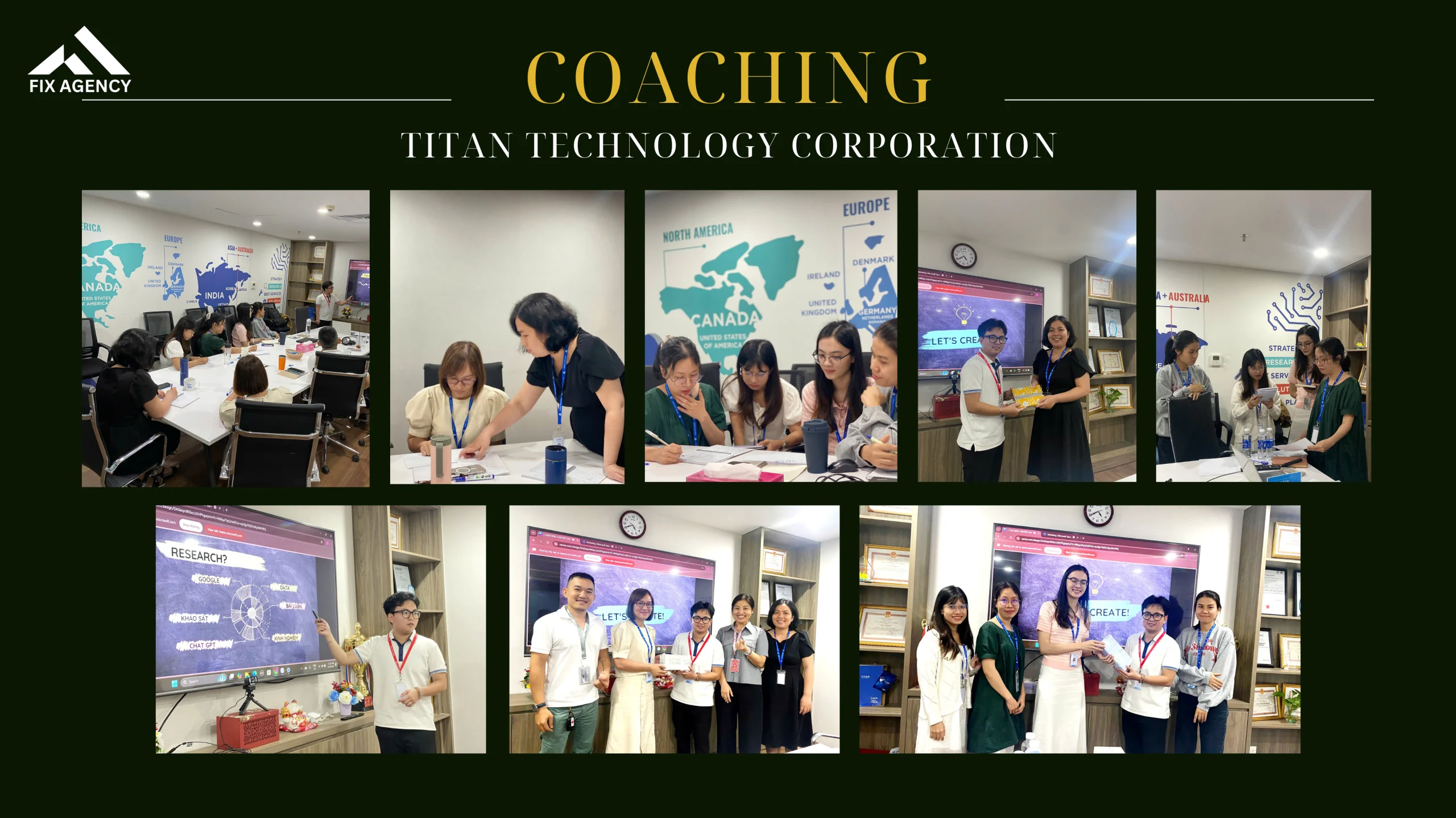
Titan Technology Corporation – Standardizing Content Across Multiple Departments
Titan’s challenge went beyond improving the writing skills of individual employees. The company needed to standardize its content system across multiple departments, align the way teams approached content from C-level executives and team leaders to interns, and establish a long-term content direction.
FIX delivered Coaching through department-specific workshops, focusing on content standards, brand voice, guidelines, execution skills, and team collaboration.
Following the engagement, Titan reported a 150-200% increase in content production speed, a 30-40% reduction in execution errors, and the development of a 6-12-month content roadmap. Employees also improved their writing, reporting, and communication skills.
The significance of this case extends beyond the numbers. The knowledge gained through training was translated into shared standards and working practices, rather than remaining dependent on each employee’s individual experience.
Mr.Bajan Foods – When Marketing Challenges Also Involve Business Operations
For Mr.Bajan Foods, the challenges extended beyond marketing alone. The business needed to improve internal processes, establish KPIs, dashboards, and SOPs, while also strengthening employees’ soft skills and cross-departmental collaboration.
Rather than approaching the situation through a standalone marketing course, FIX combined Coaching with Operational Consulting.
Following the engagement, the case recorded a 20-40% increase in team productivity, clearer documentation of key processes, and improved collaboration across departments.
This case highlights an important point: there are situations in which additional knowledge-based training is not enough. If the underlying operational system lacks clarity, individual capabilities may still struggle to translate into collective performance.

Personal Coaching – Developing Individual Capabilities and Career Opportunities
For Personal Coaching participants, objectives typically revolve around career development, professional skill enhancement, improved work performance, or personal brand building.
According to data compiled from FIX’s previous cases, 80% of participants reported a 20-50% increase in income after 2-3 months. Other cases included individuals achieving promotions, securing new jobs, or obtaining higher-value contracts.
These figures reflect the outcomes of previously delivered engagements and do not represent guaranteed results for every participant. Actual outcomes depend on each individual’s initial capabilities, objectives, level of practical application, and specific circumstances.
Although these three groups of cases addressed very different challenges, they demonstrate one common principle: Coaching delivers meaningful value only when knowledge begins to change how individuals or organizations work.

8. Start with Your Own Marketing Challenges or Those of Your Business
Ultimately, the most important question is not:
“What courses does FIX offer that I can enroll in?”
Instead, it should be:
“Where am I, or where is my team, currently facing challenges?”
The issue may not necessarily be a lack of marketing fundamentals. Content may be produced consistently but lack strategic direction. Employees may execute tasks effectively but struggle with planning. Founders may find it difficult to evaluate marketing performance. Or an entire team may possess the necessary expertise while still encountering bottlenecks caused by inefficient workflows and collaboration.
FIX begins by clarifying these challenges before recommending a program.
This means you do not need to determine in advance whether you should study Content, IMC, or a comprehensive Marketing course. Only after the initial discussion and assessment does FIX identify which areas need to be developed from the ground up, which require reinforcement, and which can move directly into practical case-based learning.
This approach also aligns with FIX’s Solution-First philosophy: start with the problem that needs to be solved, then select the appropriate solution and execution approach, rather than fitting clients into a predefined service package.
A Training & Coaching program should therefore not end simply with the feeling of “having learned a great deal of new information.”
What matters more is that, after the program, individuals have a clearer understanding of the challenges they face and know how to apply knowledge in their work. Meanwhile, businesses gain additional frameworks, standards, processes, and internal capabilities that enable them to continue operating effectively after the training program has ended.
If you are unsure whether you or your team need stronger knowledge, better skills, or more effective operational practices, start by discussing the challenges you are currently facing. FIX Agency will work with you to assess capability gaps and develop a suitable Training & Coaching roadmap aligned with the practical objectives of the individual or business.
About The Author

